It’s funny how life works. After just one week in London, due to legislative issues—legal red tape that was largely beyond my control—my employment was terminated. Some might call it bad luck. I’m starting to think it’s something else. It feels as if the road itself is sentient, as if the path I’ve chosen refuses to let me settle for the safety of a steady paycheck. The trail wanted me back, and it wasted no time in reclaiming me.
The London Departure: A Ghost Visits the Tower
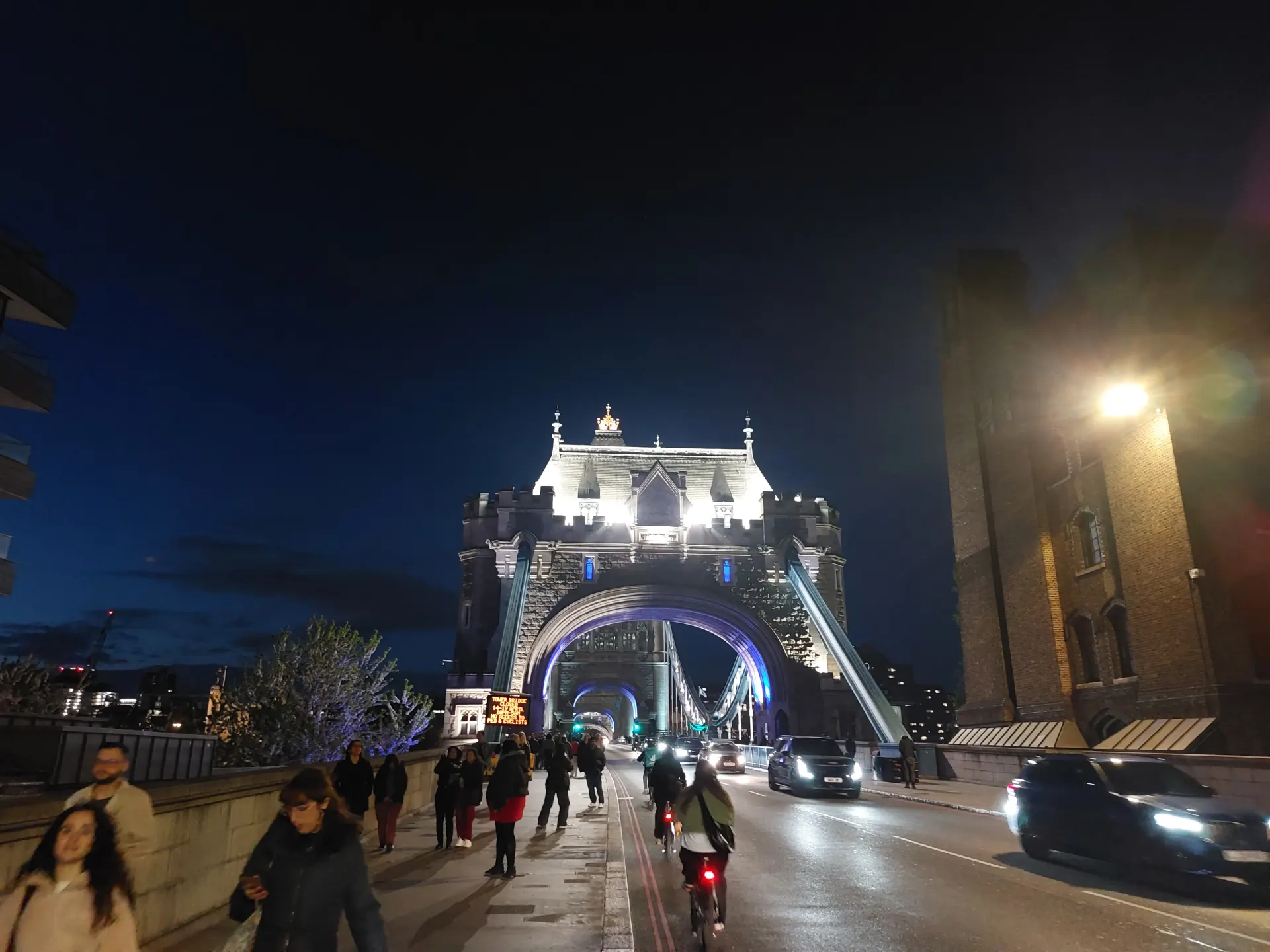
Before I left London—hopefully for good this time—I decided to break my own rule about sightseeing. Usually, I avoid the tourist traps like the plague, but there was one structure I’ve always wanted to see with my own eyes: Tower Bridge.
Standing there, watching the Victorian Gothic towers reach into the grey London sky, I realized why it fascinates me. It’s an engineering marvel of the late 19th century. Completed in 1894, it was a solution to a massive logistical problem: how to allow road traffic across the Thames without blocking the masts of the tall ships heading into the Pool of London. As a man who dreams of masts and rigging, seeing those bascules—the massive "seesaws" that lift the bridge—felt like a nod from history. It’s a bridge that respects the sea. It looks incredible, a reminder that human ingenuity can build something that is both a heavy-duty tool and a work of art.
But the city noise was closing in. It was time to head south.
The Long Walk South: Redhill and the Logic of Hills
I set my sights on Brighton. To get there, I had to navigate the transition from the concrete sprawl of Greater London into the rolling terrain of Surrey and West Sussex. My route took me through Redhill and Crawley, and it was here that I rediscovered a fundamental truth about English geography: The Law of the Hill.
If a town has "Hill" in its name—Redhill, Burgess Hill—you can bet your last pound that it was built on an incline. And if you’re walking, you can be 95% certain that the next three towns will be built on even higher ones. There is a specific kind of mental exhaustion that comes with hill-walking. Every time you crest a ridge, thinking you’ve finally conquered the elevation, the horizon betrays you. You see another peak, higher and steeper, or worse—you see a deep valley that you must descend only to climb right back up the other side.
I have a confession to make: I hate hills. Thirty years ago, when I was younger, I might have found some masochistic joy in the "challenge." Now? I find it an unnecessary tax on my knees and my patience. I’m a man of the sea. I like my horizons flat and my gravity consistent.
Engineering in the Wild: The Ouse Valley Viaduct
Between the hills, however, I stumbled upon a sight that made the climb worthwhile: the Ouse Valley Viaduct (also known as the Balcombe Viaduct). You might have seen the photo in my recent "short," but standing beneath it is a completely different experience.
Built in 1841 to carry the London and Brighton Railway over the River Ouse, it is a staggering achievement. It consists of 37 arches, but the genius lies in the "pierced" piers. When you look through the arches at a certain angle, it creates an infinite optical illusion of symmetry. They used 11 million bricks to build this thing. Imagine the logistics of that in the 1840s—no heavy trucks, just men, horses, and the sheer will to conquer the landscape. It’s a cathedral of transport.
Further on, near Burgess Hill, I passed an old windmill. It stood like a silent sentinel over the fields. I’m not entirely sure of its history or its exact name—perhaps a local "smock mill"—but I’ve included a photo. In the sailing world, windmills are our ancestors. They harnessed the same invisible force that will one day carry me across the Atlantic. Seeing it there, abandoned yet dignified, felt like another sign.
The Final Stretch: Martin’s Intervention
By the time I reached the outskirts of Brighton, about 16 kilometers from the coast, I was done. It was past 8:00 PM. The sun had long since vanished, the temperature was dropping, and ahead of me lay the South Downs—a massive wall of "hills" that looked more like mountains in the dark.
My friend Martin saved the day. He stepped in with a "logistical subsidy"—a train ticket for the final two stops. I cannot thank him enough. Walking over the Downs in pitch darkness, hating every incline, would have broken my spirit that night. Instead, I bypassed the final peaks and let the rails carry me into the salt air.
Brighton: The Edge of the Island
So, I am here. Finally. At the sea.
People often say, "Kamil, you’re on an island. The sea is everywhere." True. But believe me, sometimes the thing that is physically closest is the hardest to reach. Getting to the coast isn't just about distance; it's about breaking through the gravity of the land and the distractions of the city.
Brighton is a strange, vibrant place. It has a history that shifts from a sleepy fishing village (Brighthelmstone) to a royal retreat for King George IV, who built the bizarre, Indian-Gothic Royal Pavilion here. Today, it’s a city of pebbles, piers, and seagulls that are more aggressive than London debt collectors.
For the next few days, I am going to rest. I’m going to enjoy the beach, the sound of the English Channel hitting the shingle, and the rare gift of sunny weather. I need to recalibrate.
What comes next? I don't know for sure. I only know the rules of my compass:
- I cannot go forward, for I have not yet learned to walk on water (and the yacht is still a dream in a savings account).
- I will not go backward, because I have a visceral loathing for retracing my steps.
- I will go left or right. The coast is a line. I will follow it until the next "unexpected turn of events" pulls me elsewhere. For now, the pędzel (brush) is down. The trail is open.
Stay tuned.
Comments (0)
Leave a comment