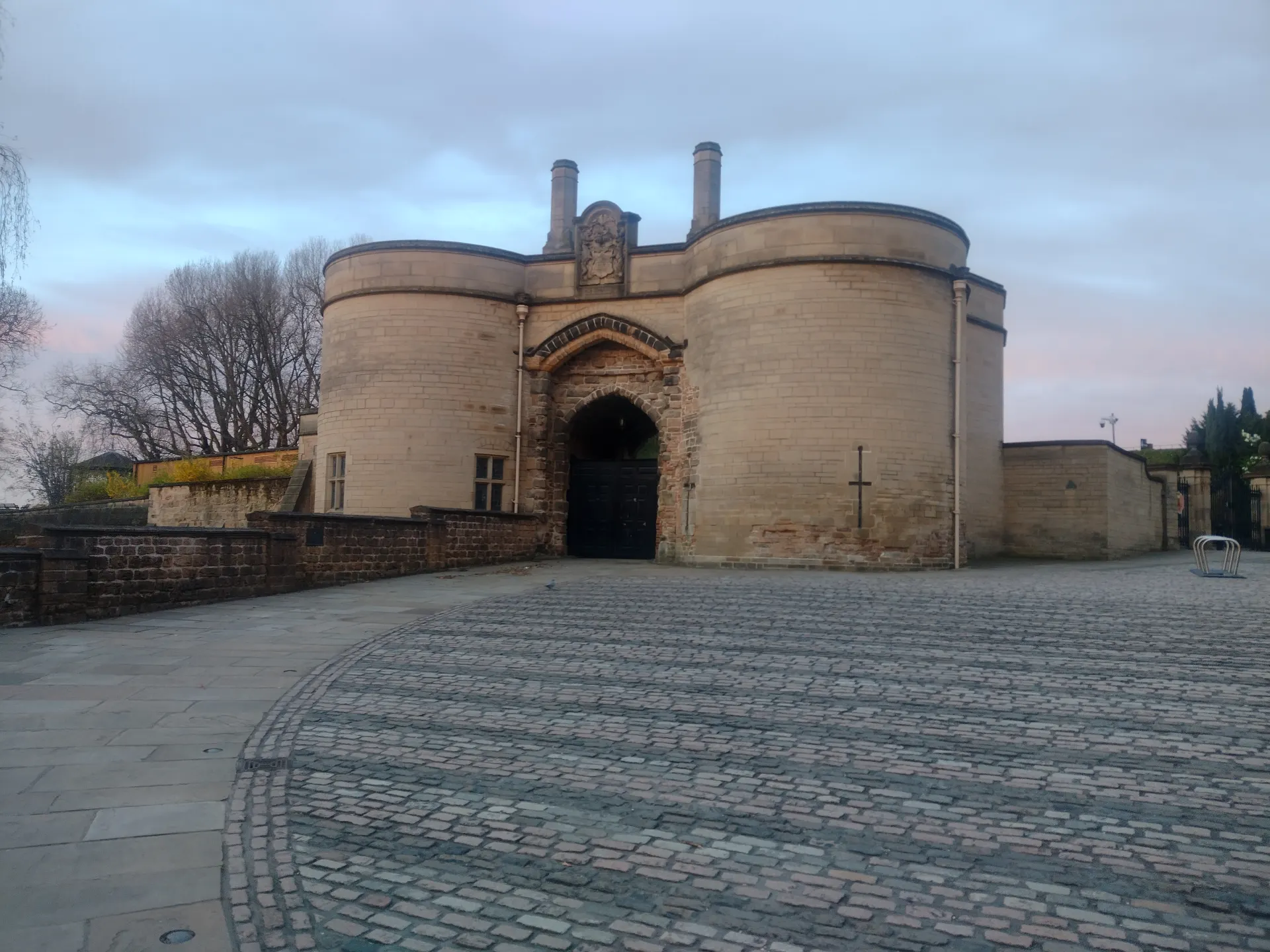
We all know the story. Robin of Loxley, the noble outlaw who hid in Sherwood Forest, robbed the rich to give to the poor, and spent his days humilating the High Sheriff of Nottingham. It’s a great tale—perfect for Hollywood and primary school plays. But as I started digging into the local history between pints of Volt IPA, I realized that the "official" version of Nottingham’s hero is mostly a masterpiece of medieval marketing.
I did my own little investigation, and the truth is far more interesting—and far more chaotic—than the legends suggest. Here is the reality of the outlaw, the sheriff, and the geography that doesn't add up.
1. The Border Dispute: Why Robin was a Yorkshireman in Disguise
Every child is told that Robin Hood is Nottingham’s favorite son. But if you look at the earliest ballads, like A Gest of Robyn Hode, our hero’s roots aren’t in Nottinghamshire at all. Robin was born in Loxley, a small village that today is a suburb of Sheffield.
The Problem: Loxley isn't in Nottinghamshire. It’s in South Yorkshire.
The Solution: So why the hell was he fighting the Sheriff of Nottingham and not the Sheriff of York? The answer lies in the medieval boundaries of the Royal Forests. In the 13th century, Sherwood Forest and the forests of Yorkshire were almost interconnected. Robin wasn't a "local" hero protecting his neighborhood; he was a mobile insurgent. He operated in the "no-man's-land" between jurisdictions. He chose Nottingham not because it was his home, but because the Sheriff of Nottingham was the enforcer for a massive stretch of the Great North Road—the main artery for wealthy travelers. Robin was a strategic highwayman; he went where the money was, even if it meant commuting from Yorkshire to work.
2. The Castle Lie: The Sheriff’s Real Address
In the movies, the Sheriff of Nottingham is always lurking in the shadows of Nottingham Castle, plotting over a map in the Great Hall. We imagine him as the master of the fortress.
The Problem: The Sheriff didn't live in the castle. Nottingham Castle was a Royal Fortress—it belonged to the King. A Sheriff was a civil servant, a tax collector, and a glorified policeman. Giving him the keys to the most important castle in the Midlands would be like giving a local traffic warden the keys to a nuclear bunker.
The Solution: The Sheriff actually lived and worked in the Shire Hall (which you can still visit today as the National Justice Museum). It was located in the Lace Market area, well outside the castle walls. He was a guest at the castle only when the King or a high-ranking noble was in town. For the rest of the year, he was stuck in a cold stone office surrounded by prisoners and ledgers, while the professional military garrison held the castle. The "epic duel" between the outlaw in the woods and the lord in the castle is a fantasy; it was actually a fight between a bandit in the bushes and a stressed-out tax man in a courthouse.
3. The "Rich to the Poor" Tax Loophole
The core of the Robin Hood brand is his legendary charity. We are told he stole from the wealthy to alleviate the suffering of the peasants.
The Problem: There is almost zero historical evidence in the original stories that Robin gave a single penny to "the poor" in the general sense.
The Solution: In the earliest legends, Robin’s "charity" was actually a form of political networking. He gave money to fallen gentry—knights who had lost their land or were in debt to the church. He was helping his own class, the yeomen and the minor nobility, not the starving serfs. The "rob the rich, give to the poor" slogan was added centuries later by Tudor playwrights who wanted to make a violent highwayman look like a saint. The real Robin Hood was more like a revolutionary financier, supporting those who could help him undermine the corrupt legal system of the time.
4. The Longbow Myth: A Weapon of Mass Destruction
We picture Robin as the master of the longbow, hitting a bullseye from 300 yards with a wooden stick.
The Problem: During the early years of the Robin Hood legends, the "English Longbow" as we know it—the six-foot yew beast that won at Agincourt—wasn't even the standard weapon for outlaws.
The Solution: The early Robin Hood likely used a shortbow or a primitive crossbow. The longbow required a lifetime of training and a specific physique (archers' skeletons are literally deformed by the tension). For a guy hiding in the thick brush of a forest, a six-foot bow is a liability—it gets caught on branches and is impossible to aim quickly. He wasn't a sniper; he was a guerrilla fighter. He used whatever worked in a brawl, including staves and knives. The longbow was added to the story later to make him a symbol of English national pride.
5. Sherwood: The Shrinking Hideout
Finally, there’s the forest itself. We imagine an endless, ancient sea of oaks where an army could hide for years.
The Problem: Medieval Sherwood wasn't just a dense forest; it was a "Legal Forest," which meant it was a mix of open heathland, farms, and small woods where the King had hunting rights.
The Solution: Robin couldn't have hidden an army there. He stayed in small, mobile cells. The reason he survived so long wasn't the "thickness of the trees," but the caves. Nottingham is built on soft sandstone and is honeycombed with over 800 man-made caves. My theory? The outlaws didn't spend their winters shivering under an oak tree; they were underground. The caves provided warmth, storage, and secret exits that the Sheriff’s men could never map. If Robin Hood existed, he was more of a "tunnel rat" than a woodsman.
The Road Ahead
So, where does that leave me? I’m sitting here in Nottingham, looking at a statue of a man who probably didn't live here, using a weapon he didn't carry, and doing things he never did.
But maybe that’s the point of the road. We follow legends to find the truth, only to realize that the truth is much grittier and more complicated than the story. Nottingham isn't a fairy tale city; it’s a place of sandstone, lace, tax collectors, and hidden tunnels.
I’ll spend a few more days exploring these caves and the Shire Hall, resting these 47-mile legs before I finally turn toward the coast. The Sheriff might be gone, but the spirit of the outlaw—the guy who doesn't fit into the system and builds his own rules (and his own CMS)—is still very much alive.
I’m currently finishing my second Volt IPA. It’s sharp, cold, and honest. Unlike the legend of Robin Hood.
Cheers from the Shire.
Kamil
Comments (0)
Leave a comment